TV Nova: Clause Libraries as an Infrastructure Decision
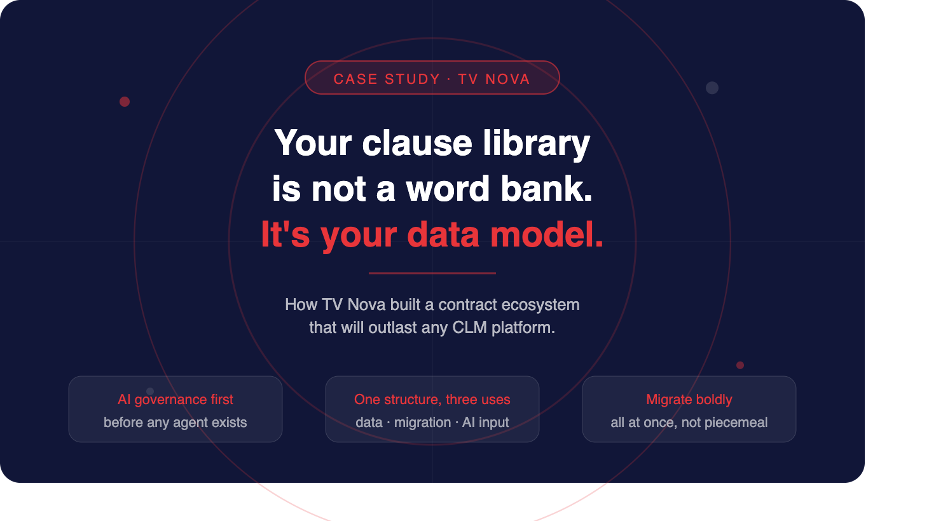
TV Nova shows why a clause library is not merely a “repository of clauses,” but the backbone of the data model for the entire contract ecosystem.
A clause library does not sound like a major project. Most legal teams see it as a collection of text blocks from which lawyers assemble contracts. The TV Nova case demonstrates why this perspective is incomplete — and ultimately leads to more expensive decisions later on.
TV Nova approached the replacement of its contract management system differently. Instead of framing the initiative as a swap of one application for another, they based the project on the design of a data model: a clause library, an element library, and metadata that should ideally survive any future platform replacement. This shift was driven by the emergence of new generations of AI models: if AI can read and interpret contracts better than a person manually navigating dozens of attributes, the logic of the entire system changes.
What Makes This Approach Conceptually Strong
Marek Svatoš, Business Systems Manager at TV Nova, framed the project in a way that remains rare even among experienced LegalTech implementations. Instead of asking, “Which CLM should we buy?”, he asked where the value lies that TV Nova wants to protect and build. The answer: in the data, not in the application.
Today, SaaS frontends are increasingly similar to one another. The enduring value lies in the data model and the content, independent of whichever vendor happens to provide the current platform.
This logic shapes the entire architecture of the project. The clause library is not managed as a Word document repository, but as master data management. It consists of structured data rather than spreadsheets, with configurability at the level of individual templates: a single data dictionary can have different allowed values and different interactive element types across different templates. This allows the same data model to be shared across templates without duplication, while each template only uses what is relevant to it.
The second conceptual pillar is AI governance established before any AI agent even exists. The principle is intentionally strict: any future AI agent used for contract drafting will work exclusively with clauses from the approved library, rather than generating free text. From a legal risk perspective, this distinction is critical. The library contains verified, reviewed, and governed clauses; free text always creates a new document that requires fresh review.
As a result, the planned proof of concept for an AI agent is not being built into a vacuum, but into a prepared governance framework.
The third noteworthy element is the explicit connection between the AS-IS and TO-BE states through the library itself. In the project, the element library simultaneously serves three purposes:
- master data for the template data model,
- a migration mapping layer between the legacy system and the new platform,
- and a machine-readable export that can be used as input for AI-generated templates.
One structure, three uses — that is infrastructure thinking, not a tool built for a single user persona.
Clause Libraries in the Broader Digitalization Ecosystem
The traditional view sees a clause library as a convenience tool for lawyers: a repository of approved wording from which users pick what they need. This view is useful, but incomplete.
In the context of CLM, AI extraction, automated template testing, and knowledge management, the clause library becomes foundational infrastructure.
In the TV Nova project specifically, the AI layer extracts structured metadata from archives of existing contracts — parties, dates, values, contract types. It identifies and clusters similar clauses across contract subtypes, detects deviations from standards, and proposes consolidated wording. The legal team therefore does not build the library from scratch; instead, they review and approve AI-prepared outputs.
The same AI layer is also used for systematic testing of template logic — conditions, variables, and generated variants — before templates reach end users.
The role of AI is therefore not to replace lawyers, but to solve the quantitative part of the work that previously made building a clause library prohibitively time-consuming. This also changes the investment equation: two years ago, no one would have approved a project involving the review of hundreds of clauses and their variants in a single step. Today, it is the only realistic way to build a library with a lifespan longer than a single platform cycle.
After the official kick-off, the team introduced a series of deliberate simplifications worth highlighting separately. The first wave of must-have templates for the upcoming go-live is being built without the clause library for regression-safety reasons. The library itself will be built after go-live, and all templates will then be migrated to it simultaneously rather than incrementally.
Metadata migration is limited only to information that cannot be extracted directly from the contract text, because AI can identify everything else in the document more reliably than humans navigating attribute tables. This reflects disciplined prioritization: knowing when to postpone nice-to-have features in order to preserve focus on must-have requirements.
Key Takeaways
Five principles for in-house legal teams and heads of legal departments considering a similar initiative:
- A clause library is an infrastructure decision, not merely a clause repository. If you build it as a Word-bank, you will rebuild it every time you replace your CLM platform.
- The template and library data model should exist outside the application. Applications come and go; the data model is a long-term asset enabling contract standardization across generations of tools.
- Establish AI governance before the AI agent exists. The principle that “the agent works only with the library” is simple, but it makes every future step easier.
- Migrate only what cannot be extracted from the contract itself. A classic mistake is migrating dozens of attributes that can already be identified from the text — making the data model unnecessarily complex and paying twice for the same information.
- Sequence boldly. Build the library in one step after go-live, not incrementally. Fourteen templates gradually reworked create fourteen opportunities for inconsistency.
Conclusion
The TV Nova case demonstrates that a clause library should be planned as part of a broader data and AI ecosystem, not as an isolated project.
At AgiLawyer, we help in-house legal teams frame these decisions before they become expensive.